Why the Moon has phases
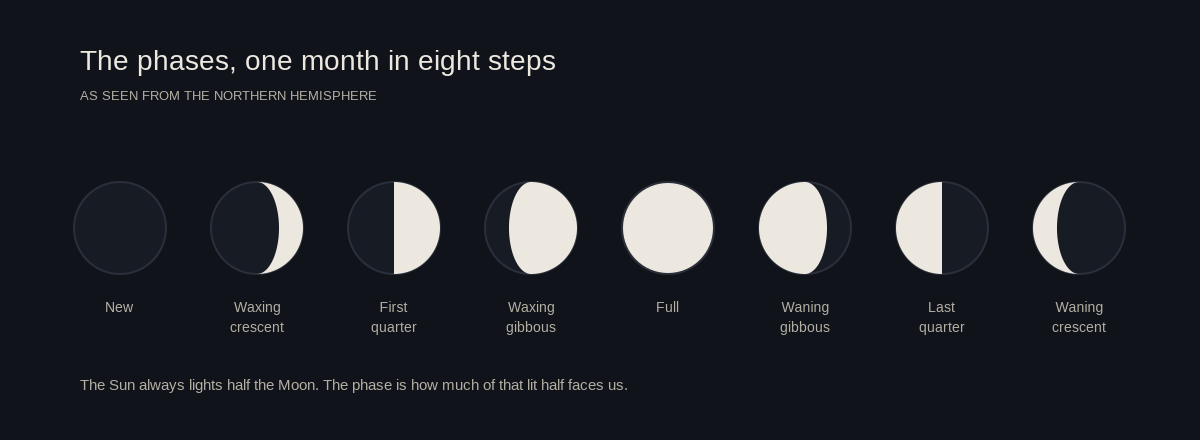
The Sun always lights half the Moon. Phases are just how much of that lit half faces us.
Half lit, always
At every moment the Sun lights the half of the Moon that faces it. As the Moon orbits Earth over about 29.5 days, we see that lit half from changing angles. At new Moon the lit half faces away from us. At full Moon it faces us squarely. In between we see crescents, quarters and gibbous shapes.
Earth’s shadow plays no part in ordinary phases. Earth’s shadow only falls on the Moon during a lunar eclipse, which can happen only at full Moon.
The same face
The Moon spins on its axis once for every orbit, so it keeps one side turned toward Earth. That is called tidal locking. Earth’s gravity slowed the Moon’s spin long ago until the two matched. A slight wobble, called libration, lets us see about 59 percent of the surface over time.
The far side is not dark. It gets as much sunlight as the near side, just at the opposite times. At new Moon, the far side is in full sun. It looks quite different too, with very few dark maria. The first view came from the Soviet Luna 3 probe in 1959, and the first landing there was China’s Chang’e 4 in 2019.
Tides
The Moon’s gravity pulls slightly harder on the side of Earth facing it than on the far side. That difference stretches the oceans into two bulges, one under the Moon and one opposite. Earth turns through both every day, which is why most coasts get two high tides about every 24 hours and 50 minutes.
The tides also drain a little of Earth’s spin and pass it to the Moon. Days get longer by a tiny amount each century, and the Moon drifts outward about 3.8 centimeters a year. Laser reflectors left by Apollo 11, 14 and 15 let observatories measure that drift to within millimeters.
See it for yourself
Over one month, note where the Moon sits at sunset. It starts near the Sun as a thin crescent and moves east each night. The lesson on how to observe the Moon tells you what to look for at each phase.
Common questions
Why is it called the dark side of the Moon?
It is an old way of saying the side we cannot see. The far side gets plenty of sunlight. Far side is the accurate name.
Why is there not an eclipse every month?
The Moon’s orbit is tilted about 5 degrees to Earth’s orbit, so most months the Sun, Earth and Moon do not line up exactly.