What Apollo brought home
The most valuable cargo of the Space Race was a few hundred kilograms of rock, and scientists are still opening it.
The collection
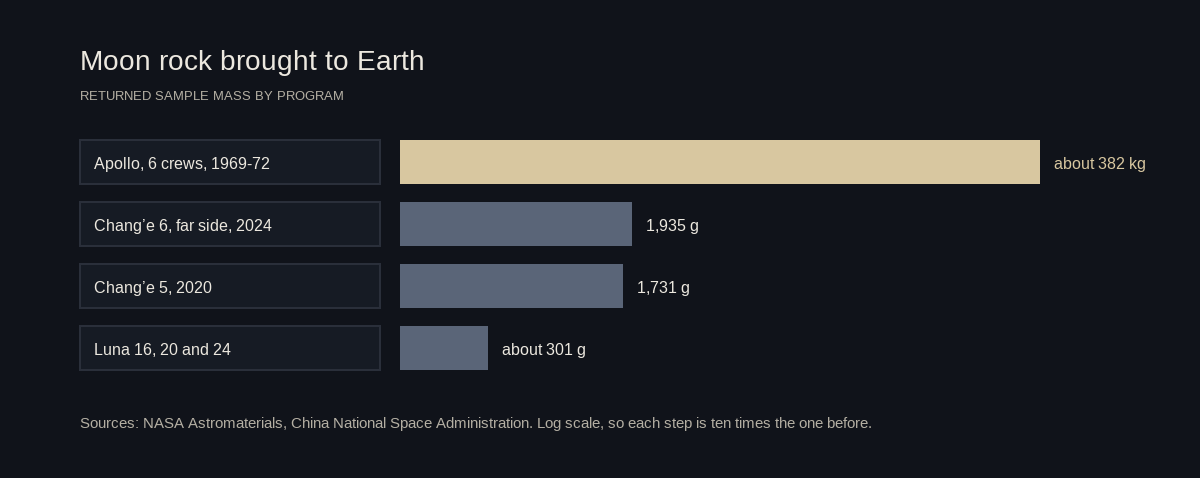
Between July 1969 and December 1972, six Apollo crews collected 2,196 samples weighing about 382 kilograms, or 842 pounds. They include rocks, pebbles, sand, dust and cores drilled up to about three meters into the surface. Most of it is held at NASA’s Johnson Space Center in Houston, in cabinets filled with nitrogen so the samples do not react with Earth’s air.
The Soviet Union’s robotic Luna 16, 20 and 24 missions returned about 301 grams in the 1970s. China’s Chang’e 5 brought back 1,731 grams in 2020, and Chang’e 6 returned 1,935 grams from the far side in 2024.
What the rocks showed
Apollo samples gave the first accurate ages for the Moon’s surface. The dark maria turned out to be lava flows around 3 to 3.8 billion years old. The bright highlands are older, made largely of a light rock called anorthosite. That pattern suggested the young Moon was once covered in an ocean of molten rock, with light minerals floating to the top.
The rocks also calibrate the solar system. Counting craters on a surface of known age lets scientists estimate the ages of surfaces on Mars, Mercury and elsewhere that nobody has sampled.
Samples opened decades later
NASA kept some Apollo samples sealed on purpose, so future scientists with better tools could study them. In 2019 and 2022 teams opened tubes from Apollo 17 that had stayed sealed since 1972, as practice for handling Artemis samples. Results from older samples keep coming too, including evidence of small amounts of water inside volcanic glass beads.
Seeing them yourself
Small pieces are on display at the Smithsonian’s National Air and Space Museum, Space Center Houston, and Kennedy Space Center Visitor Complex in Florida, which our sister site Florida Space Academy covers. Some displays let you touch a polished slice of Moon rock.
Common questions
Can you buy a Moon rock?
Apollo samples belong to the U.S. government and are not for sale. Lunar meteorites, which fell to Earth naturally, are sold legally by dealers.
Why bring back more if we already have 382 kg?
Apollo sampled a small area of the near side. New samples from the far side and the poles answer questions the old ones cannot.