How the Moon formed
The Moon is probably a piece of the early Earth, knocked loose in the biggest crash our planet ever had.
The clue in the rocks
Before Apollo, there were three main ideas. The Moon split off a fast-spinning Earth, it formed alongside Earth, or Earth captured it as it passed. The rocks brought home between 1969 and 1972 ruled against all three in their simple forms. Moon rocks are dry, poor in iron compared with Earth as a whole, and in some chemical fingerprints almost identical to Earth’s mantle.
In 1975 William Hartmann and Donald Davis published a fourth idea. A large body struck the young Earth, and the Moon formed from the debris. Through the 1980s it became the leading explanation.
The giant impact
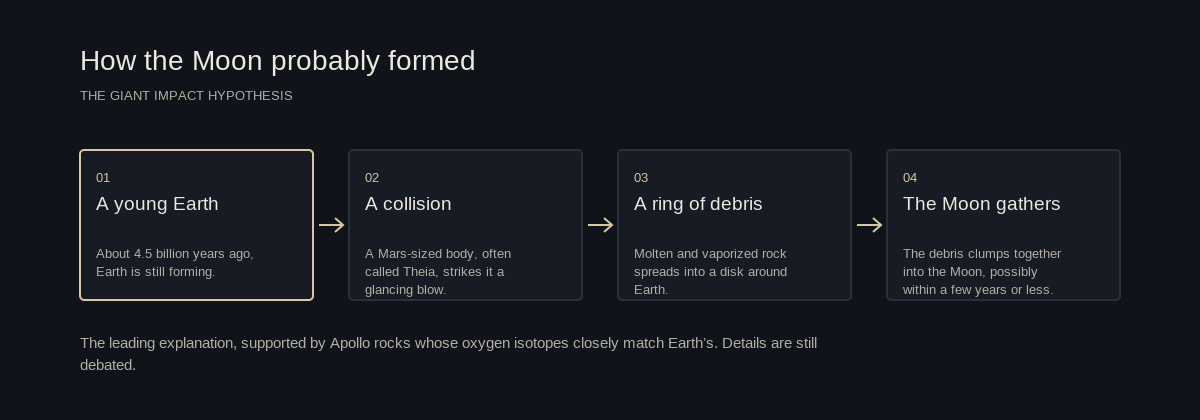
In the standard version, an object about the size of Mars, often called Theia, hit Earth a glancing blow about 4.5 billion years ago. The collision melted and vaporized huge amounts of rock. Some of it went into orbit as a disk around Earth, and the Moon gathered out of that disk.
This explains a lot at once. The Moon has a small iron core because the impact threw off mostly rocky outer layers. It is dry because the heat drove off water and other volatile substances. Earth spins fast and the Moon orbits in roughly the plane of that spin because the impact set both moving.
What still does not fit
Computer models of the classic impact predict that most of the Moon should come from Theia, not Earth. Yet the oxygen isotopes in Moon rocks match Earth’s very closely. Scientists have proposed fixes: a faster-spinning early Earth, a more violent impact that mixed everything thoroughly, or a series of smaller impacts. A 2022 simulation from Durham University and NASA Ames even suggested the Moon could have formed within hours.
New samples help. China’s Chang’e 5 brought back young volcanic rock in 2020, and Chang’e 6 returned the first samples from the far side in 2024. Future Artemis crews are expected to collect rock from near the south pole.
Why it matters
The Moon steadies the tilt of Earth’s axis and drives most of the ocean tides. How it formed tells us how common such a partner might be around other planets. To see the evidence for yourself, start with what Apollo brought home.
Common questions
How old is the Moon?
Most estimates put it at about 4.4 to 4.5 billion years old, based on the ages of the oldest lunar rocks and crystals.
Did Theia survive?
Not as a separate body. In the standard model its material ended up mixed into Earth and the Moon.