How to observe the Moon
The best time to look at the Moon is not full Moon. Here is why, and what to find on the other nights.
Skip the full Moon, at first
At full Moon the Sun is shining straight down on the side we see, so there are almost no shadows. Craters look flat. The best views come in the days around first and last quarter, when sunlight hits the surface at a low angle along the terminator, the line between day and night.
Over the following nights the terminator moves across the surface, and different features come into sharp relief. A crater that looks dramatic one evening can almost vanish two days later.
Five features to learn first
Mare Tranquillitatis, the Sea of Tranquility, where Apollo 11 landed. It is a dark, rounded patch on the eastern half of the near side. Mare Imbrium, the Sea of Showers, a huge basin in the upper left as seen from the Northern Hemisphere.
Copernicus, a crater 93 kilometers across with terraced walls, south of Imbrium. Plato, a dark, flat-floored crater on the north shore of Imbrium. Tycho, a young crater in the southern highlands whose bright rays dominate the full Moon.
Binoculars and telescopes
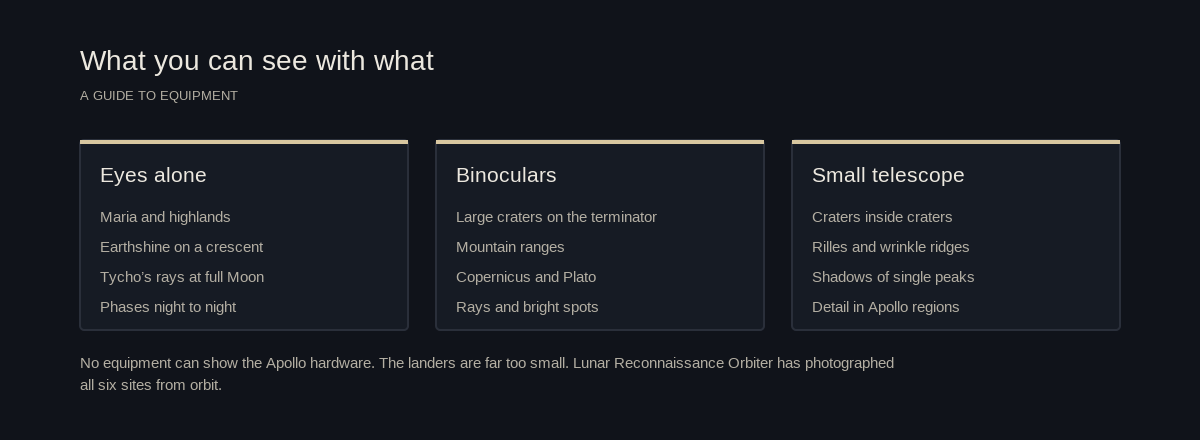
Ordinary 7x50 or 10x50 binoculars show dozens of craters and the major mountain ranges. Brace them on a wall or a chair back to stop the shake. A small telescope adds rilles, wrinkle ridges, and craters inside craters.
The Moon is bright through a telescope. Some observers use a simple neutral-density filter to cut the glare. No telescope on Earth can show the Apollo landers, which are only a few meters across. NASA’s Lunar Reconnaissance Orbiter photographed all six landing sites from orbit, and its pictures are free online.
Keep a log
Sketch or photograph what you see, with the date and time. After a month you will have watched the whole near side come in and out of the light. For the bigger story of where people will go next, see our sister site Lunar Colony.
Common questions
Is it safe to look at the Moon through a telescope?
Yes. Moonlight is reflected sunlight and is not strong enough to harm your eyes. It can be dazzling, which is why some people use a filter. Never point a telescope at the Sun without a proper solar filter.
Do I need a big telescope?
No. The Moon is close and bright, so small telescopes and binoculars show a great deal.